History of Pi Theta Epsilon
Pi Theta Epsilon is the
national honor society for occupational therapists. Established in 1958,
at the University of New Hampshire (UNH),
Pi Theta Epsilon has evolved into a nationally recognized organization.
The Alpha chapter at UNH,
which served as national headquarters for Pi Theta Epsilon between 1959
and 1970, is still alive and well.
Beta chapter, formed at
Colorado
State University, was the second chapter of the honor society for
occupational therapy students with Gamma chapter at Kalamazoo State (now
Western
Michigan) University as the third and Delta chapter at Texas Woman’s
University following as the fourth chapter. These pioneer chapters
recognized that in a true profession, scholarship and research are
necessary components in the development of the profession’s knowledge
base, as well as in the development of a scholarship-based practice
standard for providing care.
However, the society had
no national structure and apparently no way to develop one. In 1988, the
American Student Committee of the Occupational Therapy Association (ASCOTA)
asked the Board of Directors of the American Occupational Therapy
Foundation (AOTF) to sponsor Pi Theta Epsilon toward achieving
recognition as a national honor society. In response to ASCOTA’s
request, an advisory committee was established. Work was undertaken by
the student leaders to increase the number of existing chapters,
incorporate the society, register its trademark, and apply successfully
to ACHS. By March 1995, all of these goals had been accomplished except
ACHS membership, which was finally achieved in February 1996. By March
1995, there were 43 chapters!
In 1990, a constitution
was adopted through ratification by all existing chapters. A uniform
dues and fees structure was adopted through the constitution, thus
creating the first fiscal base for the organization and putting it on
the road to financial independence.
A quarterly newsletter
was adopted as the primary means for fostering communications between
chapters and between chapters and the national society. The Scroll & Pen
serves as the vehicle for soliciting nominations for officers, promoting
the agenda for the annual national meetings, and alerting members to
important events such as nomination deadlines for the President’s Award,
the Award of Excellence, and the Mary J. Bridle First Research Award.
The Executive Committee
posed three purposes as the focus of the organization during the next
several years: To stimulate, recognize, and reward clinical practice
that demonstrates authentic occupational therapy; to stimulate,
recognize, and reward educational systems that support scholarship,
research, and critical thinking in students and faculty; and to
stimulate research through a program of awards and mentorship.
On November 23, 1993 the
Pi Theta Epsilon Service Mark was published in the Trademarks Official
Gazette. A Certificate of Registration was issued soon thereafter.
PTE Eligibility Requirements
-
Demonstration of
superior scholarship
-
Scholarship rank of
35% or higher among classmates
-
3.5 GPA since
entering the occupational therapy program
-
Completion of credit
hours used by the institution to designate one full academic term
equivalency in an entry level baccalaureate or post-baccalaureate
program in occupational therapy
-
At least one entire
semester must remain after initiation before leaving for a fieldwork
placement
-
A piece of scholarly
written work, completed while enrolled in the occupational therapy
program, must be submitted as evidence of the applicant’s abilities
-
Submission of a
short essay (250 words) stating why he/she wishes to join PTE
Community Service
By choosing a career path that is dedicated
to helping others, Pi Theta Epsilon members find it important to
participate in several community service projects throughout the year.
The 2007-2008 community service projects include sponsoring a can food
drive, Coats For Kids drive, Trick or TKE, developing communication
boards for patients in hospice, and backpack awareness.
Survival Kits and Tip
Sheets for Peers
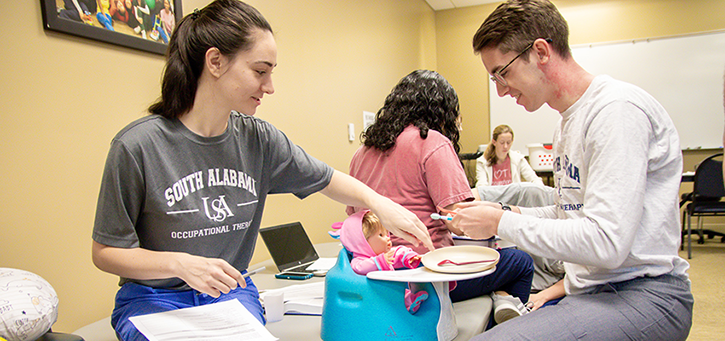
In addition to providing
extra learning opportunities, the members of Pi Theta Epsilon also
provide peers with survival kits for Level II fieldwork and tip sheets
for incoming occupational therapy students.
Leadership for Future
Occupational Therapy Students
As leaders, Pi Theta Epsilon
members conduct Pre-Occupational Therapy Association meetings. They
present informative occupational therapy seminars to the
Pre-Occupational Therapy Association members in order to prepare them
for the application process into the USA Occupational Therapy graduate
program. |