GY 402: SEDIMENTARY PETROLOGY (W)
(3 credits) 

Dr. Douglas W. Haywick
 

Bulletin Description:
A  study of sediments and their classification, as well as sedimentary processes, petrography and diagenesis. Prerequisites: EH 102, GY 302, GY 304.
Objectives and Goals:
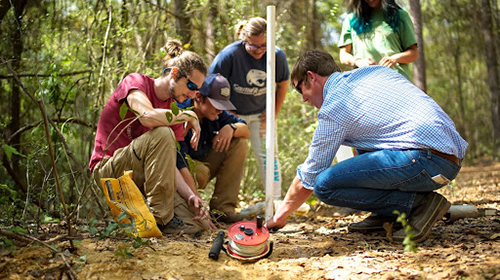
This course will examine the physical make-up of some of the most important rocks we have on the planet (certainly along the Alabama Gulf Coast!); the sedimentary rocks. You will be introduced to the most common nomenclatures used to name those rocks and sediments, the techniques used to identify them, and the parameters responsible for their origins. Laboratories will be used to introduce you to the physical properties of sediment and sedimentary rocks. Several required field excursions will take place in this class. The one to Moscow Landing will be a three day mini field school. GY 402 also requires substantial computer use. Most students already have access to personal computers; however, the Department has several available for your use. These computers have licensed copies of Word/WordPerfect, PaintShop Pro, Excel/Quattro and several sedimentary geology application packages (e.g., TriPlot). You will also need an active E-mail account for this class. GY 402 has EH 102, GY 302 and GY 304 as prerequisites.  

Syllabus for Current Semester (PDF format*)

GY 402 Assignment Due Dates and Field Trip Schedule

Doug's Current Semester Schedule
Letter Head for Writting Assignments (.doc [Word 2003] format)
Grain size Spreadsheet (.xls [Excel] format)

Twit this Class! (Read what past students recommend for surviving GY 402)

GY 402 Stuff
(Note: Downloads are available when cell background is coloured)
-(.pdf format) - (other formats) -(Vimeo video files)

Week
#

Subject Material
PPT Lecture
Lecture Notes
On line Videos
1
1: Origin of Sediment
2: Grain Size Parameters
2
3: Fluid Dynamics
4: Sediment Classification
3
5: Bedform Development
6: Sedimentary Structures
 
4
7: Sedimentary Sections
 
8: Sedimentary Facies
 
9: Walter's Law
 
5
10: Mature Sed. Petrography
 
11: Near Shore Environments
 
6
Mardi Gras Holiday
12: Flume Group Activity
     
7
13) Immature Sed. Petrography
 
14) Alluvial Fans
 
8
15) Moscow Landing
 
Catch-up Day
     
9
Spring Break
10
16) Siliciclastic Diagenesis
 
17) Sandy Fluvial Systems
 
11
18) Volcaniclastic Petrography
 
19) Deltaic Dep. Environments
 
12
20) Evaporites/Tidal Flats
 
21) Non-Skeletal Allochems
 
13
22) Skeletal Allochems
 
23) Shelves
 
14
24) Reefs
 
25) Temperate carbonates
 
15
26) Carbonate Diagenesis 1
 
27) Carbonate Diagenesis 2    
16
28) Carbonate Diagenesis 2    
Final Words/Lab exam
   
Lecture Test 1
Lecture Test 2

Lab Assignments
Lab 1: Ternary plotting exercise
Lab 2: Bogus sed section exercise
Lab 3: Flume activity
Lab 4: Mature siliciclastic thin sections
Lab 5: Immature siliciclastic thin sections
Lab 6: Siliciclastic diagenesis thin sections
Lab 7: Volcaniclastic thin sections
Lab 8: Tidal flat and evaporite thin sections
Lab 9: Skeletal allochem thin sections
Lab 10: Temperate carbonate thin sections
Lab 11: Carbonate diagenesis thin sections

Small Writing Assignments
Write 1: Breakdown of a term paper
Write 2: Grainsize Project: Hypothesis and Methods
Write 3: Grainsize Project: Introduction and Results
Write 4: Moscow Landing Project: Literature Review
Write 5: Moscow Landing Project: Stratigraphy
Write 6: Common man/woman letter

Major Project Assignments and Guidelines
Major 1: Grain Size Project
Major 2: St Stephens Quarry Section
Major 3: Moscow Landing Project
Moscow Landing Field Trip Information

Peer Review Assignment Forms
Peer 1: Grain Size hypothesis and methods
Peer 2: Grain Size introduction and results
Peer 3: Moscow Landing stratigraphy

Exams
2012 Midterm Exam (available Feb 28, 2012)

 * You will need a PDF reader to view\print these files. Go here to download Adobe Acrobat

Text books (optional):
Walker , R.G., and James, N.P. (eds.), 1992: Facies Models. 3rd Ed. Geosci. Can. Rep. Ser. 1, Toronto.
 
Lab Manual:
There is no lab manual required,  however, you will have to have the following for the labs:

1) hard covered notebook
2) hand lens
3) good quality pencils (colored and graphite for drawing), pens and a compass
 

Useful? Course Information:
Assessment:
Participation*
10%
Peer Review Exercises
05%
Grain Size Group Project
10%
St Stephens Group Project
05%
Moscow Landing Project
15%
Small GSSA Writing Assignments
10%
Lab Assignments
15%
Final Lab Exam (in class)
10%
Mid Term Exam (take home)
10%
Final Exam (in class)**
10%
Total
100%
   

* One of the major goals of this class is to stimulate your critical thinking. This is done by me asking specific individuals questions during class (Socratic method) and you participating in group activities, field trips and in-class discussions. Pay attention in class because you never know when it will be your turn to be put on the spot. I will assess you on how well you do.

Grading:
A 90+
B 80 to 89
C 70 to 79
D 60 to 69
F 59 and below
 
Writing Assignments:
 

GY 402 is a W (Writing-Across-the-Curriculum) class, which means that it is writing intensive. The purpose of W classes is to not only provide you with the opportunity to “write”, but to help you to improve your writing skills. In GY 402, you will be able to write in a number of “styles” that are both useful and relevant to all of the geology professions. These “styles” include: professional letters, cover reports, memos, geological lab reports and the ever popular (but much maligned), sedimentology projects (see the GSSA bleb below). In order to help you develop appropriate writing skills, each of the “W” assignments that you get will be assigned will be “re-doable” following submission and review of a first draft. Three of the assignments will also be subjected to peer review whereby your fellow students will provide comments in addition to those provided by the instructor. Remember; the purpose of all this is to improve and develop your writing skills in geology . Refer to the class website for due dates and redo dates for each of the assignments.


The GSSA: You will get occasional small writing assignments based in part upon the following premise: you are employed as sedimentologist with the GSSA, the Geological Survey of South Alabama. Every report that you produce (even boring lab reports) will be considered a company document. As such, it should have an appropriate “cover” (either on letterhead or memo paper), be well written without spelling mistakes/grammatical errors, contain, where necessary, a bibliography of refereed references, and contain adequate reference citations. Your signature and company position should also appear in the appropriate location on the cover letter. Ultimately, in your role with the GSSA, you will be responsible for completing 3 major projects: 1) a group report dealing with sediment grain size on a site somewhere that you define at Municipal Park; 2) a group project involving production of a composite sedimentary section of Eocene limestones at St Stephens Quarry and, 3) a project involving the mapping and interpretation of K/T boundary chalk beds near Moscow Landing Alabama. The first and last projects will be broken up into a number of components each due at a specific date, and each revisable for re-marking after I or your peers review it for you.

The following assignments will comprise the bulk of the small writing assignments in GY 402:

  • Write 1: Breakdown of a term paper (Week 1)
  • Write 2: Grain size hypothesis and methods (Week 2; Peer reviewed)
  • Write 3: Grain size introduction and methodology write up (Week 4; Peer reviewed)
  • Write 4: Moscow Landing Library Research Assignment (Week 8; Peer reviewed)
  • Write 5: Moscow Landing Background/Stratigraphy (Week 10)
  • Write 6: Common man/woman exercise (Week 14)

In addition, expect the following in short duration (usually 1 lab session), non-re-doable “fun” lab activities:

  • Lab 1: Data plotting exercises (Week 1)
  • Lab 2: Bogus Sedimentary Section (Week 2)
  • Lab 4: Sedimentary flume experiment (Week 6)

From week 6 until the end of the course, the weekly writing component will largely consist of a short thin section discussion that will be handwritten in your lab note books. Use pencil as these discussions are re-doable (however, the thin section descriptions are not). All writing assignments (1 st drafts and revised versions) are due by 5:00 pm on the assigned due dates as listed on the course website. I will not accept late assignments (you will get an F). When I mark them and return them to you with comments, you will be permitted to resubmit them once for revised assessment. I will accept revisions up to the re-submission deadlines posted on the web page (usually 1 week later than the original due date).


Due Dates webpage.

Laboratories
 

It is up to you to examine the rocks and thin-sections that are assigned in this course and to do all additional laboratory assignments. You may do this during the lab periods and\or outside of normal university hours. A good chunk of your mark in GY 402 will be based upon lab material (lab test, quizzes etc). Spend suitable time in the lab going over the crystallographic models and minerals. Refer to the web page for lab assignment due dates. I do not give extensions; labs assignments not turned in on time will not be accepted (you get an F for that assignment).

 
Exams:

The reason for producing a syllabus is to give students advanced notice of exams and assignment due dates. Translation: there is no excuse for missing an exam. However, sometimes it happens. If you have a legitimate excuse for missing an exam (i.e. medical problem), you will be permitted to write a make-up during the last week of classes provided that you show me a signed certificate from a medical doctor stating that it was impossible for you to make the exam. The make up exam will consist of 2 essay questions with no choice on your part. The Final lab exam will consist of a thin section and hand specimen description exercise of a sample drawn randomly from a hat. The sample pairs will be from a similar suite to those that you examined during the petrography labs in the class. You will be able to use your lab note books during the final.

The fine print:
Plagiarism and cheating are not permitted in this class and either of them will result in severe embarrassment to you (and quite possibly an F for the assignment or exam in question) if you are caught doing them. Be sure to use proper reference citations in your take home exam otherwise it’s plagiarism. See me if you need help about this before the exam.

Disabilty disclaimer:

In accordance with the American's with Disabilities Act (ADA) students with bona fide disabilities will be afforded any reasonable accommodation. The Office of Special Student Services will certify a disability and advise faculty members of reasonable accommodations. If you have a specific disability that qualifies you for academic accommodations, please proved us with certification from the Office of Special Student Services, directed by Ms. Andrea Agnew, and located in the Student Center, room 270. The phone number is 460-7212.

Changes in Course Requirements:

Since all classes do not progress at the same rate, instructors may wish to change the number and frequency of exams, or the number and sequence of assignments. Inclement weather (e.g., hurricanes) may also force rescheduling of lectures, assignments or exams. When ever possible, this material will be made up. Students will be given adequate written notice of any changes in lecture sequence, assignment due dates and/or exam date changes.


How & where to find Doug:

I reside in LSCB room 049. I believe in open office hours, so feel free to pay me a visit anytime between 9:00 am & 5:00 pm. However, I do research and serve on a lot of committees so I may not always be in my office. I  keep regular office hours. To see my current schedule, click the button below

 
Where's Doug

 This page is maintained by Dr. D. Haywick. Please feel free to email 
him if you have any questions concerning it.
url: http://www.usouthal.edu/geology/haywick/GY402/gy402.htm