| |
To
provide quality health care, the student is expected to possess
functional use of the senses of vision, touch, hearing, taste,
and smell. All data received by the senses must be integrated,
analyzed and synthesized in a consistent and accurate manner. In
addition, the individual is expected to possess the ability to
perceive pain, pressure, temperature, position, equilibrium, and
movement.
The
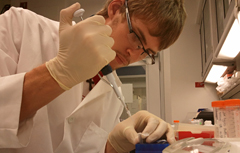
student is expected to participate in and observe demonstrations
and experiments in the basic sciences, including but not limited
to physiologic and microscopic study of tissues in normal and pathologic
states. In addition, the student is expected to observe the
patient accurately at a distance and close at hand and accurately
assess health/illness alteration. Inherent in this observation
process is the functional use of the senses and sufficient motor
capability to carry out the necessary assessment activities.
The
student is expected to be able to effectively communicate verbally
and non-verbally and to observe patients in order to elicit information,
describe changes in mood, activity, and postures and to perceive
non-verbal communications. This requires the ability to effectively
utilize the English language in verbal and written interactions
with patients, their families and other professionals in the work
environment. The student must be able to communicate effectively
and sensitively with patients.
The
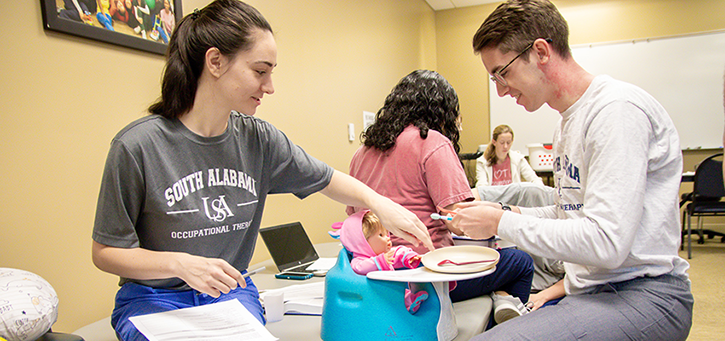
student is expected to be able to perform gross and fine motor
movements required to provide occupational therapy services and
operate equipment to deliver care safely. Examples of movements
the student must be able to perform include lifting, turning, transferring,
transporting, and exercising of patients. The student is
expected to have the psychomotor skills necessary to perform or
assist with occupational therapy evaluation procedures (i.e., manual
muscle testing, joint range of motion), occupational therapy interventions,
handling of equipment, and emergency interventions. The student
is expected to be able to maintain consciousness and equilibrium,
and have the physical strength and stamina to perform satisfactorily
in clinical experiences.
- Critical Thinking
Ability
The
student is expected to have the ability to develop problem-solving
skills. This includes the ability to measure, calculate,
analyze and synthesize objective as well as subjective data and
make decisions that reflect consistent and thoughtful deliberation
and clinical judgment. In addition, the student should be
able to comprehend three dimensional relationships and understand
the spatial relationships of structures.
- Interpersonal
Abilities, Behavioral and Social Attributes
A
student must possess the emotional health and stability required
for full utilization of his/her intellectual abilities, the exercise
of good judgment, and the prompt completion of all responsibilities
attendant to the assessment and treatment of patients. The
student is expected to establish rapport, and develop and maintain
mature, sensitive, and effective relationships with individuals,
families and groups from a variety of social, emotional, cultural,
and intellectual backgrounds. Students must be able to tolerate
physically and emotionally taxing workloads and to function effectively
under stress. Students must be able to adapt to changing
environments, to display flexibility and to learn to function in
the face of uncertainties inherent to the clinical problems of
many patients. Compassion, integrity, concern for others,
interpersonal skills, interest and motivation are all necessary
personal qualities in order to successfully complete the training
required to become an effective and competent occupational therapist.
Individuals
with disabilities are encourage to apply to the Occupational
Therapy program. However, upon acceptance of the offer of
admission to the professional component, it is the responsibility
of the student to notify the Chair of the Department of Occupational
Therapy (Dr. Rebecca I. Estes, (251) 434-3939) if there is any
reason why the abilities/expectations described above cannot be
met. Students who indicate that they cannot meet one or more
of these and who request a review in writing will be reviewed by
the Departmental Faculty Committee and the Coordinator of Special
Student Services to determine what, if any, reasonable accommodations
might be possible to facilitate successful completion of the degree
requirements.
|